
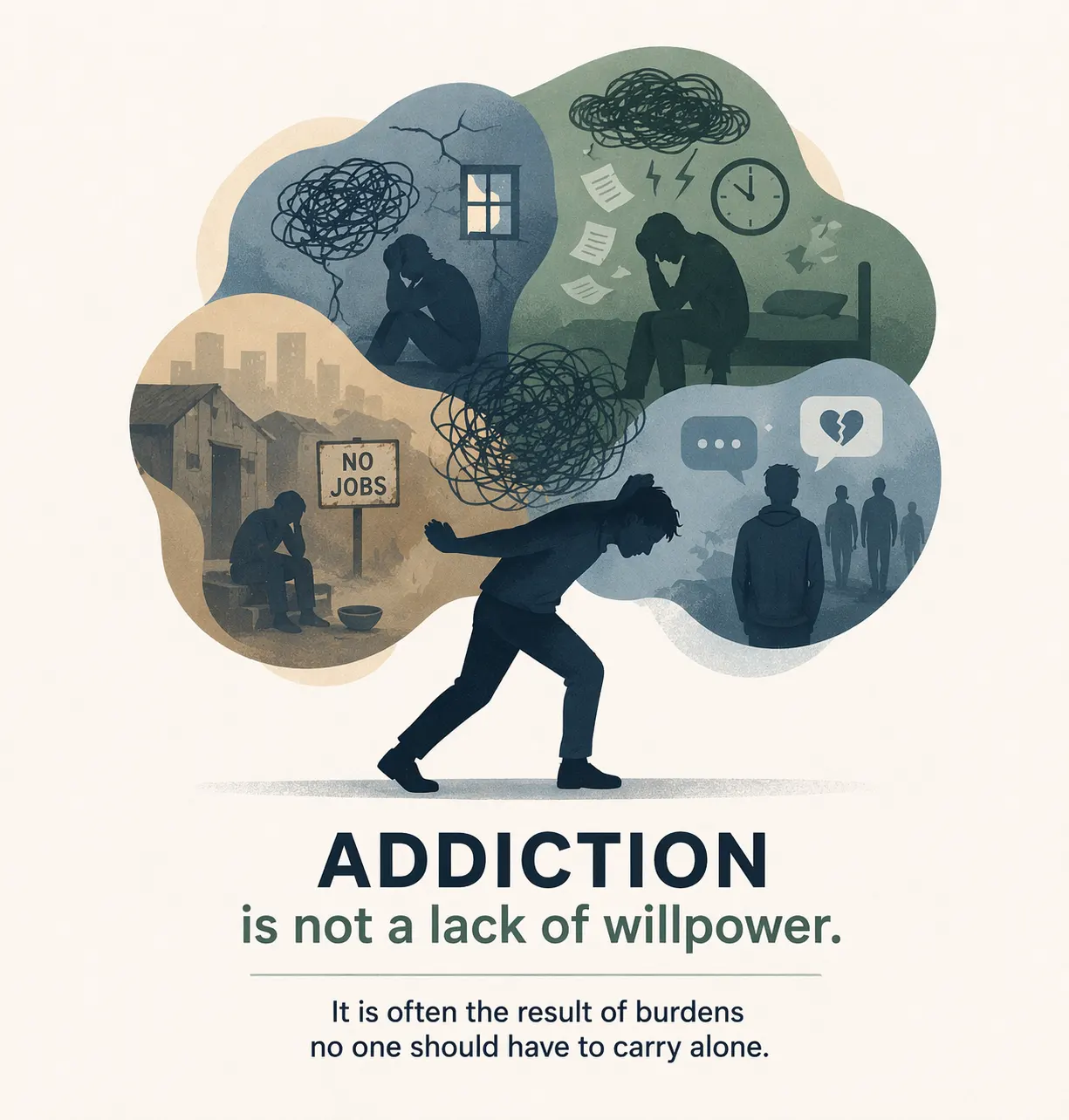
One belief persists in conversations about addiction, which is that individuals struggling with substance use disorders have a lack of willpower. We often hear phrases like ‘he should just stop’, ‘he doesn’t want to stop’, ‘she doesn’t care about anything enough to stop’ or ‘she just enjoys it too much to quit’. Such phrases reflect a deep misunderstanding about the disease.
This belief is not only inaccurate; it is harmful. It reduces a complex human condition to a question of character, and in doing so, obscures the realities that sustain it.
To understand addiction more meaningfully, we must move beyond judgment and begin to examine the broader psychological, biological, and social forces at play particularly within the context of Pakistan.
Nature of Addiction
Substance use may start as a choice but not addiction. Repeated use of substances alters the brain’s reward system, reinforcing patterns of behavior that prioritize short term relief over long term consequences. Over time, this process weakens the brain’s ability to regulate impulses, make decisions, and resist cravings. An individual’s brain function is altered; their body becomes so dependent on the chemical that the process of withdrawing from it ranges from extremely painful to lethal.
What emerges is not simply a habit, but a cycle that is maintained by both neurobiological changes and psychological dependence.
In such a state, asking someone to stop is not the solution.
Addiction in Pakistan
Within Pakistan addiction exists within a particularly complex social environment. Despite increasing prevalence, substance use remains heavily stigmatized. It is often framed as a moral failing rather than a health concern. As a result, individuals and families may conceal the problem, delaying intervention until it reaches a critical stage.
Access to mental health services remains limited, and where services do exist, they are often inaccessible due to cost, location, and/or lack of awareness. Preventative education is minimal, and conversations around emotional wellbeing are frequently avoided or dismissed. In this context, addiction stops being an individual issue and becomes a systemic issue, one that AAS Foundation along with its donors works very hard to resolve.
Addiction & Survival
For individuals from underprivileged backgrounds, the experience of addiction is often compounded by conditions that extend far beyond individual control. Poverty, unemployment, unstable housing, exposure to violence, and limited access to education create environments of chronic stress. In these settings, substances may become one of the few available means of escape not out of choice, but out of necessity for psychological survival.
At the same time, access to treatment is significantly restricted. Rehabilitation services are often unaffordable or geographically out of reach. Even if the institution stands, the quality of treatment does more harm than good due to addiction not being recognized as a disease and therefore adequate treatment is undelivered. Public health systems remain under-resourced, and community-based interventions are limited.
This creates a cycle that is difficult to break:
- Increased exposure to stress and adversity
- Greater vulnerability to substance use
- Limited access to support
- Higher risk of relapse
Inaccuracy of the will power narrative
Willpower, while often emphasized, is only one small part of a much larger picture. When addiction is reinforced by biological changes, emotional pain, and environmental stressors, individual determination alone is rarely sufficient to sustain recovery. Attempts to stop without addressing these underlying factors often lead to relapse.
This is not a reflection of weakness. It is a reflection of complexity.
Effective recovery requires more than motivation. It requires access to care, psychological support, stable environments, and long-term intervention. If addiction is understood solely as a personal failure, the response will continue to be punishment, exclusion, or silence.
If, however, it is understood as a condition shaped by multiple interacting factors, the response can shift toward compassion, evidence-based care, and systemic change. This shift is not simply about changing languages. It is about changing outcomes.